


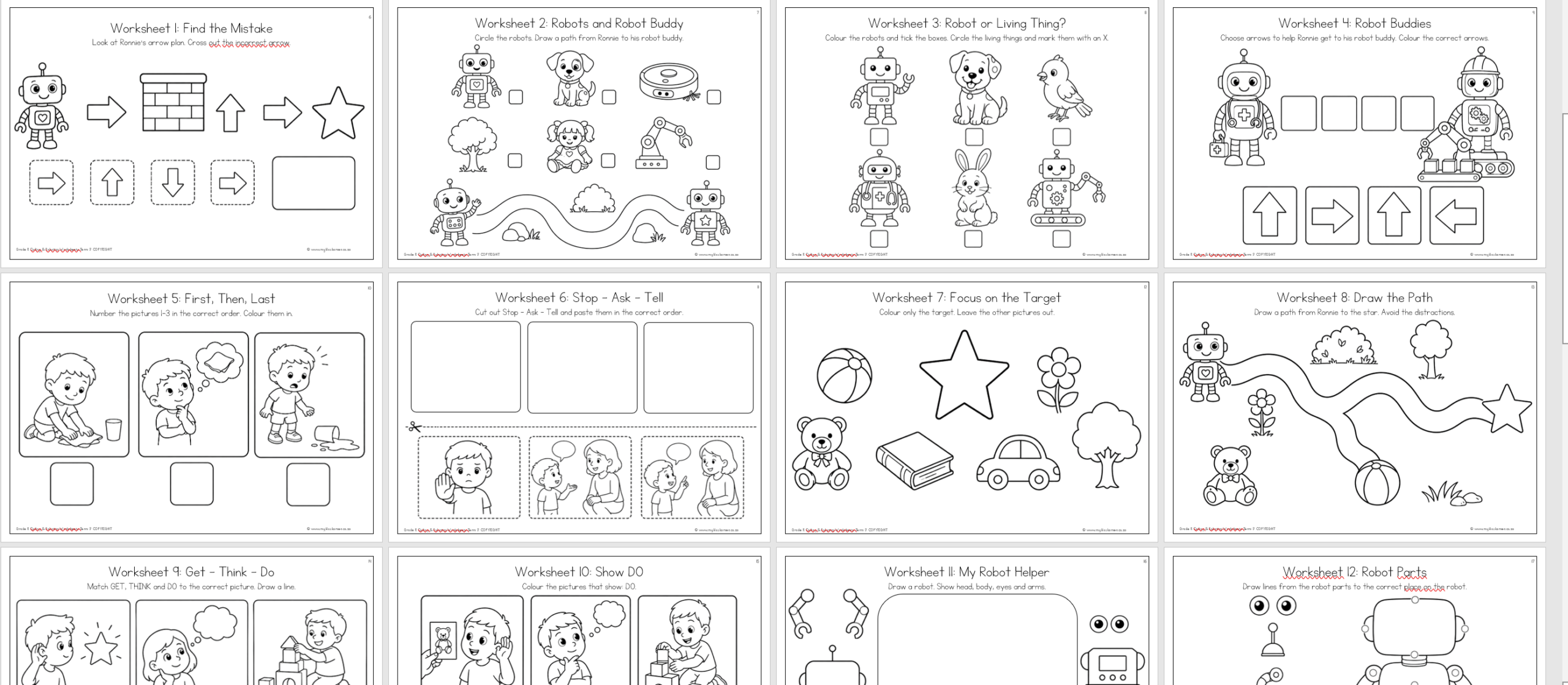
My Klaskamer’s Grade R Coding & Robotics lesson plans for Term 3 build on the skills developed in Terms 1 and 2. In this term, learners move beyond simple routes and arrow plans towards testing, finding errors, and improving plans — still in a concrete, playful, and developmentally appropriate way.
This package is specifically designed for Grade R learners and focuses on simple computational thinking, robotics, and digital safety through practical, unplugged activities. Learners discover that a robot follows a plan, that a plan may sometimes contain an error, and that we can calmly test and fix the plan. The Term 3 lesson plans therefore place strong emphasis on testing plans, spotting errors, debugging, and using devices safely.
What do learners learn in Term 3?
Learners develop a deeper understanding of:
• Robot buddies and robots as machine helpers
• Simple arrow plans and routes
• Spotting errors in a plan
• Debugging — fixing one error in a plan
• Breaking tasks into smaller steps
• Focusing on the important target and ignoring distractions
• Get – Think – Do as simple plan-thinking
• Robot parts: eyes/sensors, arms, wheels/feet, and body
• Recognising and completing patterns
• Screen time, outdoor play, and safe choices
• Stop – Ask – Tell for digital safety
• Understanding picture messages on devices
Everything remains practical and concrete: learners move, test, look, think, and fix.
How do the lessons work?
Each lesson follows a fixed, simple structure:
• Clear lesson aim and learning outcomes
• CAPS competencies
• Key concepts for the lesson
• Practical lesson flow
• Oral teacher questions
• Mini-checkpoints
• Closure and reflection
The lessons continue to follow the important do-first learning pathway:
Body → Floor Grid / Concrete → Paper
Learners therefore first experience the concept with their bodies, then test it using concrete materials on the mat, and only then complete the worksheet. This supports the Term 3 guideline that worksheets should not be used too early; the concept must first be established through concrete experience.
What makes Term 3 different?
• More focus on testing and fixing
• Learners begin to understand that the plan may be wrong, not the robot
• Stronger use of debugging
• More purposeful use of Get – Think – Do
• More work with robot parts and robot helpers
• Patterns are linked to simple data and messages
• Digital safety is revised and reinforced
• Learners practise finding one error and fixing only that part
Term 3 is therefore the term where learners begin to show that they can not only follow a plan, but also check whether the plan works, spot the error, and improve it.


Monique K. (verified owner) –
Great program and easy to follow